Why a Week Has Seven Days, Even When Months Do Not
Why a week has seven days reflects an ancient calendar tradition, not the shape of a month. Learn how the cycle became established and read dates clearly.
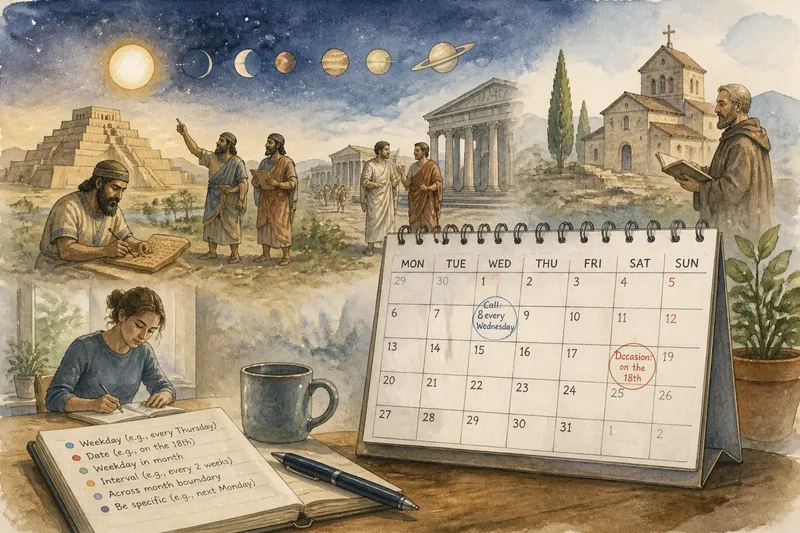
The common mistake is to assume a week has seven days because seven divides neatly into a month. It does not, and that assumption makes recurring plans confusing. Why a week has seven days is a question of historical convention: the cycle took shape in ancient societies and spread through religious and civil calendars, rather than being derived from the length of a month.
Separate the cycles
A week is a repeating sequence of seven named days. A month groups numbered dates, and its length does not usually divide into whole weeks. A year organises months and dates on a still longer cycle; neither boundary resets the weekdays.
Think of the week as a loop and a month as a page showing part of it. The page may begin or end halfway through the weekday sequence, so calendar displays often show dates from neighbouring months in the same row. The weekdays continue in order regardless.
This distinction matters when you record a routine. “Every Tuesday” follows the weekday cycle; “on the 12th” follows a month’s numbered dates. Those instructions can coincide, but they do not mean the same thing.
Ancient origins
The seven-day cycle was in use in ancient Mesopotamia and became prominent in Jewish practice, where the Sabbath falls on the seventh day. In the Hellenistic period, the seven-day week was also associated with the seven visible celestial bodies known to ancient observers: the Sun, Moon and five planets visible to the naked eye. These traditions helped shape the week that later entered Roman and Christian life.
Roman timekeeping did not move directly from an ancient seven-day week to a universal modern calendar overnight. The seven-day cycle became established in Roman society during the early centuries of the Common Era, alongside older ways of marking time, and Emperor Constantine’s civil calendar reform in 321 CE formally recognised the seven-day week in the Roman Empire. As Roman influence and Christianity spread, the pattern travelled widely and became embedded in civil calendars.
That history explains why seven is a convention with deep cultural roots, not a number forced by the shape of months. Other societies have organised time differently, and the seven-day pattern gained authority through repeated religious and civic use. Once people shared the cycle, it provided a common framework for naming and coordinating days.
Choose the right label
For a recurring event, decide whether you mean a weekday, a date, or both:
- Observation: The activity should happen on the same weekday. If its weekday matters, then write “every Thursday”; otherwise, use the date-based or interval-based wording that matches the plan.
- Observation: The event belongs to a numbered day of the month. If the date matters, then write “on the 18th of each month”; otherwise, use a weekday recurrence if the weekday is what must stay fixed.
- Observation: The event is tied to a weekday within a particular month. If both conditions matter, then write “the first Thursday of each month”; otherwise, specify only the weekday or date that controls it.
- Observation: The event is scheduled a set interval after another one. If the interval is two weeks, then count two complete seven-day cycles; otherwise, state the actual date if the target is a calendar date rather than an elapsed interval.
- Observation: A calendar row includes dates from two months. If you need the complete week, then read across the month boundary; otherwise, record only the dates belonging to the month relevant to your task.
- Observation: A plan says “next Monday” but does not identify which Monday. If the timing could be unclear, then add the date; otherwise, keep the weekday wording when the shared context makes the intended day clear.
Say you are arranging a recurring call and noting an occasion on the 18th. Start with those two inputs: the call must recur on Wednesday, and the occasion is fixed to the 18th. Put “every Wednesday” in the call entry and the month and date in the occasion entry; as the calendar changes, the call remains on Wednesday while the occasion remains on the 18th, even if they fall on different weekdays.
Calendar questions?
Why does a month not start on Monday?
Months follow numbered calendar dates, not a reset of the weekday cycle. Since their lengths do not generally contain a whole number of seven-day cycles, the first date can fall on different weekdays.
Does a week belong to one month?
Not necessarily. A displayed calendar week can include dates from two adjacent months because the weekday sequence carries on across the boundary.
Is a week one seventh of a month?
No. A week is a fixed seven-day cycle, while a month follows its own calendar length. Treating the week as a fraction of a month makes recurring plans harder to describe.
Why use weeks for recurring plans?
Weekdays return in a clear sequence, so they are convenient labels for routines that recur on the same day. Use a numbered date when the event must stay attached to a particular day of the month.
Read dates clearly
Read a date as two pieces of information: its weekday and its position in the month. Add the month and year when needed to distinguish it from another occurrence. For a recurring plan, name the condition that must remain fixed rather than relying on a calendar layout to imply it.
It is not worth trying to force each month into identical weekday blocks or to treat it as a stack of complete weeks. The uneven edges simply show where independent cycles meet. A quick glance at the weekday and date is clearer than mental conversion.
Why a week has seven days comes down to an old cycle that became shared through religious and civil use, not a neat fit with months. Keep the weekday and the numbered date distinct when you write plans, and you will know which part of the calendar is meant to stay the same.