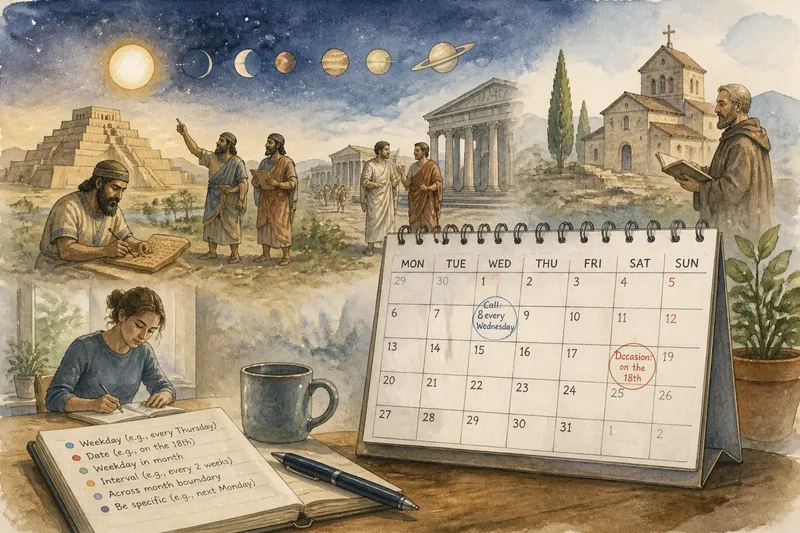
How the Two-Day Weekend Took Shape
The origins of the weekend lie in uneven rest days becoming a shared break. Learn how Saturday and Sunday came to shape the working week.
The most common mistake about the origins of the weekend is to treat Saturday and Sunday as a pair that has always existed. For a long time, days of rest depended on local custom, religious observance and occupation, so time off did not necessarily coincide with anyone else’s.
Rest before weekends
In many Christian communities, Sunday was set apart for worship and rest. That did not make it a universal day off: rules and customs varied, and farming, household labour and essential services continued.
Other communities observed a different weekly holy day. Jewish observance centres on Shabbat, from Friday evening to Saturday evening; Muslim communal prayer is especially associated with Friday. These practices shaped weekly rhythms, but did not themselves establish a standard two-day break for all workers.
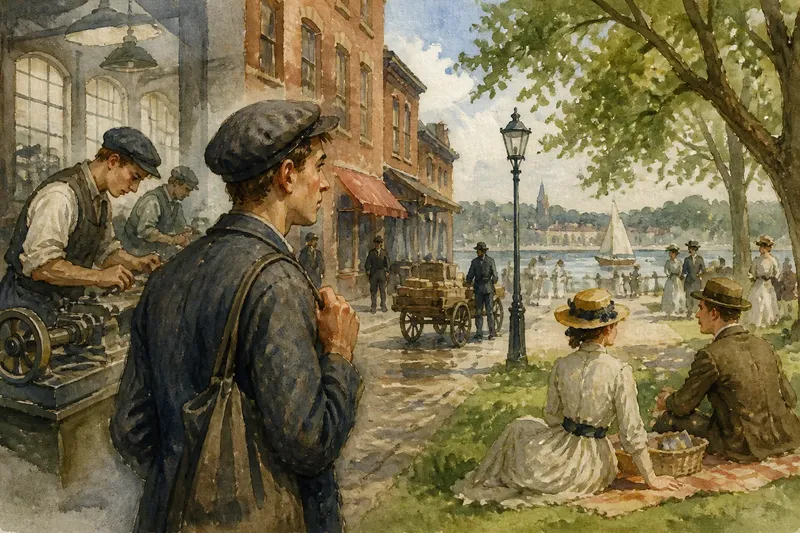
Work schedules depended on occupation and local arrangements. A shop, workshop or farm might keep different hours from a factory or office. Some workers had Sunday free but worked long hours through the rest of the week; others received a shortened day or a local half-holiday.
Saturday shifts
The important change was not simply gaining another day off. Saturday began to acquire a different role: it remained part of the working week, but in some workplaces it was shortened or partly set aside, allowing it to join Sunday as a continuous break.
In nineteenth-century Britain, Saturday half-holidays became an established custom in some trades and workplaces. Their spread was uneven, and the timing and form varied. Rather than implying a single national transition, this points to a gradual change shaped by local practice and working arrangements. Campaigns for shorter hours also made leisure time a matter of collective working conditions.
A Saturday afternoon off was not the same as a full day of rest. It could leave time for errands, sport, visiting or travel, while Sunday remained the principal rest day for many. Where Saturday hours contracted, people could begin to plan activities across consecutive days.
The value of overlap
Two days could make room for more than a single day’s worship, household tasks and recovery before work resumed. A longer visit, club gathering or outing might fit without squeezing every activity into Sunday.
Overlapping free time also made social plans easier. Colleagues, families and friends could meet without negotiating a different rota for everyone. The weekend became not only a personal benefit but a shared expectation: people could anticipate that others might be free at the same time.
That expectation never applied to everyone. Shift workers, domestic workers, transport staff and hospitality teams often worked while others rested. The two-day weekend is best understood as a widely influential pattern, not a rule that describes every person’s week.
How did weekends settle?
Was Sunday always a day off?
No. Sunday had religious and cultural importance in many places, but work continued in occupations and households where it was necessary or customary. The scope of Sunday rest varied by community, job and local rule.
Did Saturday become free all at once?
No. Shortened Saturdays and half-holidays appeared unevenly, with different workplaces changing at different times. The shift from a Saturday afternoon break to a paired weekend was gradual, not a single universal decision.
Why did a shared weekend catch on?
A common break made social plans easier because people could expect some overlap in their free time. It also gave workers a collective way to think about hours and rest, rather than treating each person’s leisure as an isolated arrangement.
Do all communities observe the same weekend?
No. Work schedules and weekly days of rest differ across countries, religious communities and industries. Even where Saturday and Sunday are customary, many people have different days off.
Find the local rhythm
The history is easiest to notice in ordinary details: a market closing early on Saturday, a club meeting on Sunday afternoon, or a workplace rota that keeps weekend shifts staffed. These are signs of a broad custom meeting local life, not proof that everyone shares the same schedule.
Say you want to arrange a regular visit with a relative who works shifts. You ask which day their rota usually leaves free, compare it with your own calendar, then suggest a recurring time on a day both of you can manage. The observable result is a plan based on actual overlap rather than an assumption that Saturday and Sunday are available.
Tracing every local half-day rule is not worth the effort unless you are studying a particular town or trade. The useful point is that the paired break emerged through uneven changes, not one sweeping invention. The origins of the weekend explain why Saturday and Sunday feel like a unit to many people, while the local rota still determines who can share that time.